Friday, February 28, 2014

Challenge #11: Child vs. Career


****Warning: House of Cards season 2 spoilers****

          It's fairly recent struggle that most women have to face as they grow up: to have kids or to pursue excellence in a career? Now, that statement makes it sound like the two are mutually exclusive, which is not necessarily true. However, numerous articles have been written about how balancing the two is incredibly difficult, such as here and here. I can write from personal experience - my mom is a single mother, who travels for work and is often gone 3-4 days out of the week. There are times when her work schedule and my debate schedule conflict, and we can go weeks without seeing each other. It's hard, and I have vivid memories as child of her missing soccer games and school performances. 


It’s undeniable that the traditional American family has shifted since the 1950s. The wildly popular Modern Family only serves as proof, along with census data. Women are having children later, we’re having fewer children, and we’re having them out of wedlock – be that be as single mothers, in domestic partnerships, or other circumstances. But what has been consistent is the pressure to still have them. Sure, women might get some side glances if they have grey hair while toting along a five year old, but people will still want to know his/her name and squeeze his cheeks.
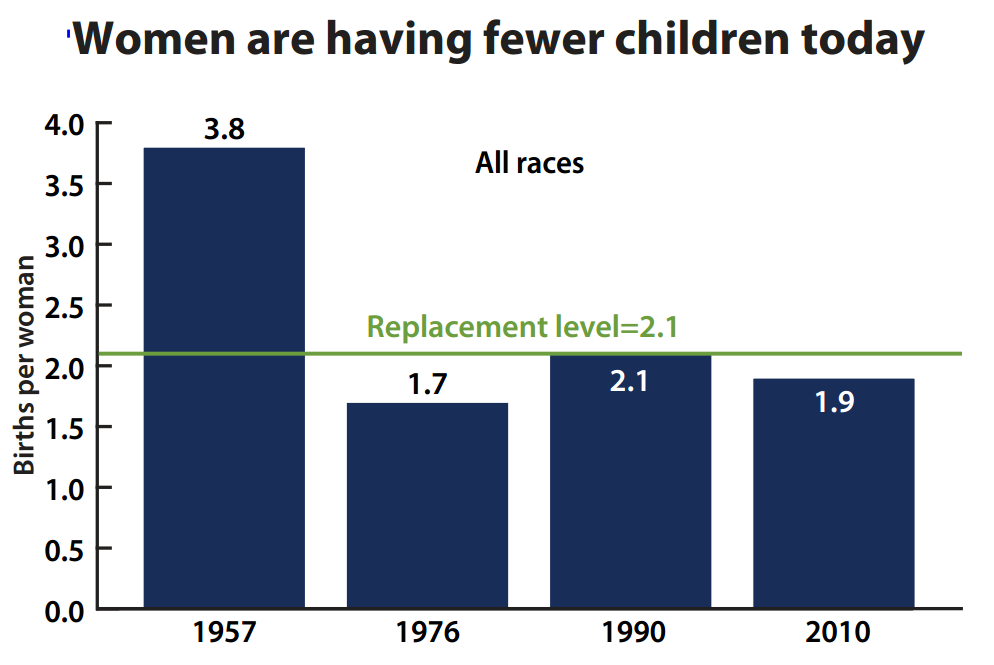


But what about those women who choose careers? Are they automatically branded as selfish or unlovable? Too uptight to get married or to settle down? Another modern tv show, Netflix’s House of cards, exposed the criticism women face. It shows the female lead, Claire Underwood, being forced repeatedly [watch the video in the link] to justify her and her husband’s decision to not have kids. The reporter wouldn’t take the answer most women give, that Claire wanted to devote her life to public service and didn’t feel like she could split her time effectively (the classic decision to choose career over kids), as sufficient or worthy. She goes on to press Claire if her relationship with her husband was real, or if she’s infertile. It was truly uncomfortable to watch.

There is a real stigma against women who don’t have children, even though it’s becoming more and more common. 1 in 5 American women in their early forties don’t have kids [link]. At 17, that worries me. I can’t begin to imagine being married within 5 or 6 years, yet alone having children. Many of my friends feel the same. I’ve planned more about my future when it comes to college, grad school, my career path and where I want to live than I have about what color my bridesmaids will wear or what to name my firstborn. Does this make me defective? Some will probably tell me yes.

There’s also a stigma against women who choose to try and do both, as proven by the 2012 controversy over Yahoo CEO Marissa Mayer when she was pregnant.  So, where does that leave women with aspirations other than motherhood? Dealing with, as Helen Mirren said, ‘boring old men.’

Cia,
Charlie 

Friday, February 7, 2014

Challenge #10: Women and Politics

To be honest, I'm really sick of my ovaries being the butt of political jokes. However, I don't think I'm those jokes are going to stop anytime soon. It's February 2014 - the 41st anniversary of Roe vs. Wade just passed, and America is gearing up for the good-old mid-term election (and primaries!). The cast of candidates is nothing if not entertaining - Clay Aiken, openly gay American Idol runner-up, is competing in a heavily conservative North Carolina district - and with the GOP looking to strengthen its majority in the Senate and Democrats looking to cling to the lead in the Senate, I can sense a return of 2012's 'war on women'. See cartoon below. 
applicable political cartoon 

The GOP knows it, too. They’ve held ‘training camps’ for incumbent, male candidates who will have to defeat female Democrats in November. They’re especially necessary, considering even after the 2012 election, politicians have made awful, ignorant comments - most recently Mike Huckabee at the RNC’s winter meeting. (Props to my friend Julia for showing me his comments in the Oracle, our school newspaper, article). Huckabee accused the government of providing women with the birth control pill, which is necessary to ‘control their libido’.


Gag me. Most male politicians (Democrats included) could learn a lot for the Oracle article. The GOP leadership shouldn’t be teaching their candidates how to politely interact with women - they should be making re-take a basic sex ed class, and learn how the states the represent actually define buzzwords like rape and abortion rules. I agree that they have a right to their opinion - but they should be able to explain the facts behind the female reproductive system before they should be able to make a legal ruling on ‘when life begins’.


Another sad aspect of the media’s focus on these comments is that they’re not all that important when it comes to voting. Sure, the media’s able to taint a candidates image, but even for women voters, issues like the economy mattered more than abortion and social issues when they cast their ballot - only when men went to the very extreme end of the spectrum, and publicly, did it really matter.


What does this all add up to? I don’t want the 2014 midterms - and the 2016 presidential election to be another ‘war on women’. However, it might be inevitable, especially if the GOP favorite Paul Ryan is the nominee, and the Democrats nominate Hillary or another women.  The same Paul Ryan who doesn’t think I, as a child born from IVF, should exist. Examples like this from Ryan’s past would be easy targets for opposition research.

However, women can try and make the issues they care about matter, because women are increasingly the determining factor in elections. We have higher voter turnout rates than men, which means our votes count. Let’s make sure that they do.  


Cia,
Charlie

Profile: Angela Merkel


She's been named the most powerful woman in the world by Forbes multiple times. She's led the 4th largest economy in the world for 8 years, and is beginning a third four-year term (never mind that fact that she's the first women to ever hold her position). She is Angela Merkel, Chancellor of Germany.

My interest in Merkel began at the beginning of this school year. There's a tradition that Academy (a cross-school program I'm a part of) seniors are assigned countries when we start in August. As part of our current events class, we have to follow the country and report on major events. I was given the Federal Republic of Germany. When I started, my knowledge of Germany was limited to World War I & II, and I knew almost nothing about the present German state or Merkel as its leader.   

In the months since I'm chronicled everything from Merkel's impressive reelection to her pelvic break (ouch!). It's been interesting to see how a country and the media reacts to Merkel as the country's leader, as someone from the United States which has yet to have a female behind the big chair in the Oval Office. I've determined that the Germans are far more accepting of Merkel than Americans are to the closest thing we have to Merkel, Hillary Clinton.

Merkel is able to go about her business without much discussion about her pantsuits or haircut, unlike Hillary. Granted, I haven't read much about Merkel's original campaign for Chancellor in 2004, so I don't know if those were originally covered heavily by major news corporation and have just tapered off over the last 8 years, or didn't exist in the first place. However, this isn't a post about Hillary. Although there's definitely one in the making.


'Mum' Merkel, as she's been nicknamed, has had a rocky road as a female politician. She's liked by most people in her country, and has been seen as a stabilizing, reasonable, focused ‘motherly’ force (she also has a PhD quantum chemistry!). However, she  has been criticized as being too strict with Germay's austerity policy towards struggling European Union countries, and domestically, she takes very slow steps to solve problems.

What still makes her so well liked, and so contrary to the United States, is her ability to compromise. She’s compromised with most of her opposition parties, and sometimes on the foreign front in small increments. She compromised to create the ‘Grand Coalition’ of the CDU and SDU parties that begins in the legislative branch of Germany’s government this year, instead of keeping the political process hostage in negotiations over the coalition. She’s going to work with David Cameron, Prime Minister of the UK, to ensure his country doesn’t leave the EU. All of these actions are in the best interests of the German people, the German government, and Europe as a whole.


Were Merkel to take these actions in America, it’d be seen as ‘appeasement’ to the enemy, and a display of weakness. In Germany, it’s viewed as responsibility, and that shows how much leaders like Obama and John Boehner can learn from her actions. Or, they could just keep wiretapping her phone….

Cia
Charlie 


Sunday, January 12, 2014

Challenge #9: Reflection


I had mixed feelings about senior year blogs at the beginning. I had blogged twice before, once in a personal setting and once for my sophomore year English class. I dreaded every time I needed to post for the sophomore blog, because we had little freedom with what we blogged about – our teacher would give us topics, and I didn’t like being so limited, so I was hesitant about starting Challenges ♀f Charlie.

My worries were appeased with the idea of using an umbrella or a lens. I chose a feminist umbrella, which is a topic I’m interested in. It’s made coming up with blogging topics easier because it’s usually research I would’ve done even if I wasn’t writing a blog. I tend to genuinely like the ideas for my blogs, like when I examined Frozen and Scandal, which again helps the writing flow. I’ve learned that I write better when I’m personally connected to the topic. For example, blogging about Malala and my views about education, as a student, came a lot easier than blogging about Islam and the veil because I don’t know many people who are Islamic or who wear a veil. That will unquestionably affect how I choose what to write about second semester.

As first semester has continued, I’ve gotten better at incorporating more into my posts, ‘more’ being more multimedia, linked articles, and pictures. When I scroll through the page and see the posts lined up, the newer, higher posts are a lot more colorful than ones closer to the bottom. I’ve always been good at doing research before I write about something, it’s a habit from debate and definitely a strength as a blogger, but now I’m finding information easier to incorporate and link to.

However, I’ve struggled to balance that research and explanations with original analysis. When I wrote my blog about Frozen, I originally had half of the blog post as an explanation of the plotline, because I felt like the reader should understand it before I made my points. However, this left little space for me to actually make the points, due to the limited attention span of the average reader. I ended up only including the plot points I thought necessary, and interlocking the arcs with the analysis to make sure the post flowed. I’ll keep working on editing to find an explanation/analysis balance next semester.

My favorite Academy blog is easily Jacob Levin’s, because of its humor and because he posts more prolifically than the rest of us. When I check feedly, he almost always has a  new post, which I can’t say the same for myself or the rest of this classmates. I’ve laughed out loud when I read his satire, especially when it’s directed at other Academites, such as ‘"I don't care what these scientists say about the whole global warming conspiracy," noted local dimwit Alex Kaplan,’ from his global warming post.

On a more serious note, I also like Katy’s blog and Jack’s blogs because they make it very easy for the reader to comment. Katy covers ethical dilemmas, and Jack takes the side of the ‘devil’s advocate’ and they both cover controversial topics, like religion in schools or ‘selfies,’ but they only express their opinion and leave the rest of the debate to play itself out in the comments section. I want to do a better job of incorporating the reader into my blog posts, so people feel like they can comment because they have something to say.

I believe the idea of ‘incorporating the reader’ should be the direction that Academy blogs should take. I think it’d be an enlightening experience if, say, a third of the class was assigned to blog by one date, and then the remaining two-thirds of the class had a few days after that to debate in the comment section, almost in the spirit of a moodle discussion only more student-driven. I think right now the way we blog is very shallow and not integrated. People write just to get the assignment done, and comment in the same fashion. I’ve rarely seen more than 2-3 comments on a blog, and the comments themselves are unconnected islands, which isn’t how a blog or a comments section is supposed to work. I think that system would encourage higher quality blog writing, because the writer will know 10+ academites will be reading it, and more depth to the conversations that will play out later. 


(748 words)

Cia♀,
Charlie

Challenge #8: Princess Expectations

Frozen promotional banner - the snowman (Olaf) is my favorite because he loves summer!

***Spoilers ahead****
I'll be honest, I'm not a big movie person. I never see them in theaters, and even though I have a Netflix subscription, I stick to binge watching bad TV than the numerous movies I could watch at the click of a mouse. I watched three seasons of Gossip Girl (a probable post for the future) over winter break while most of my friends saw the movie above, Frozen. When I got back to school, everyone was raving and singing the songs and I thought, perhaps I should give this one a chance. So, in a rather large break from finals studying this weekend, I loaded it up on my computer and sat back in bed. 

My first impression that it was undeniably cute. It started off with two cherub-like little girls singing about snowmen. What's not to love? I mean, from a feminist standpoint....a lot. The animation distorts the female body - literally, the eyes of Anna and Elsa, the female protagonists, take up a third of their face and are bigger then their wrists. But that's pretty common across all of Disney's animations, and for this post, I want to defend Frozen from a feminist standpoint. 

There are two main things about this movie that I think make it a huge step forward from the typical Disney-damsel-in-distress movie: first, the male characters and second, the relationship between the sisters. 
The men of frozen: Kristoff, an ice-trader, and Hans, a prince with twelve older brothers
Take a look at the two men in front of you. They're the two love interests for Anna. Now it's Disney. Who do you think she ends up with? If you guessed Prince Hans you'd be.....wrong! Finally, a Disney movie where the Princess doesn't marry the Prince. Happily ever after is changing. 

Now, Anna meets Hans first and experiences the typical Disney whirlwind romance. She's never been on a date before, but of course they meet in a cute coincidence and dance at the ball until he proposes before the night is over. Realistic? Heck no. But that's not where the story ends! Anna runs off to save her sister and meets Kristoff. Then it's revealed that Anna, whose heart is turning to ice, needs to be saved by a 'true love.' 

She tries to get Hans to kiss her but he reveals that he's actually an evil megalomaniac. Score for Disney! Not only does she not get the Prince, but they also squashed the idea of love at first sight/marrying your true love. In almost every Disney movie, the princess marries the first boy to cross her way. That happens to uh, no one in real life. We go through many significant others until we finally find 'the one'. Anna isn't even saved by Kristoff - even though they do love each other which is awesome because Kristoff is a totally ordinary character. He's a common, loveable working man, not a prince. 

Which brings me to...the other thing I love about Frozen. 


A tale of two sisters: my wonderful sister, Carolyn, and I,
and the sisters in Frozen, Anna and Elsa
The sisters' 'true love' is what saves the kingdom in the end! For me personally, I love this because I have a close relationship with my sister. We fight like Anna and Elsa, but we also protect each other the way that Anna and Elsa do. I know she'd have my back way faster than any boy I've dated. This is again, a major change for Disney and makes many feminists (and sisters!) very happy. The two girls took initiative and used each other to save their kingdom, not the new man in their life. 

I hope girls everywhere who see this movie will take that message to heart, and that Disney continues to stray away from their usual plotlines by embracing all that a strong female character has to offer. Then, maybe we can work on changing the animation. 

Now, I really do need to go study for finals! 

Cia♀,
Charlie 


"In Summer" from Frozen, by Olaf, the snowman.
 It's the most adorable song by far, 
because the snowman doesn't know
 that he'll melt in summer. 


Saturday, January 4, 2014

Challenge #7: 2014


2♀14

It was New Years Eve, 2013. I was getting ready to host my friend, Kendall, for a night of baking (or, fulfilling traditional gender roles, as she would say) when suddenly the commercial below popped onto the screen. I turned around when I recognized the voice of the first girl, Malala Yousafazi, who I blogged about here, and was mesmerized for the next minute. I'd heard of most of the women it mentioned - Malala, Janet Yellon, Gabrielle Giffords. and Margaret Thatcher - but not all of them. I was inspired by their stories, whether I'd known them before or not, and felt proud to be a woman in a year that unfortunately had a lot of negative publicity for women. From Miley Cyrus's monthly scandals, to Kim Kardashian's baby-naming coverage, I felt like the women who were really making a difference daily had been overshadowed. 


The commercial made me hope for a better 2014, for all women, everywhere. It'll be a big one for me, personally. I'll graduate high school and enter college, and join other women who make up the majority of college students nationwide.  Two out of the three colleges I've been accepted to have more females enrolled then males - and at Georgetown, there's a 12 point gap (56% female, 44% male). 

2014 will also see more women take power. Angela Merkel will leader Europe's largest economy, Germany, for a third term. Janet Yellen will continue to act as the first female Chairwoman of the United States Federal Reserve. We'll have the 2014 mid-term elections, where women's issues will continue to play a large role in how citizens vote. Women running for office will (hopefully) continue to succeed and lower the gender imbalance in Congress, where they currently make up one-fifth of all Senators and about 18 percent of all Representatives. Both Democrats and Republicans are succeeding in getting women to run for office. I know I personally would love to spend my summer working on a woman's campaign in Illinois. In 2013, women were credited with ending the shutdown of the federal government - who knows what they'll accomplish across the spectrum in 2014.

Tulsi Gabbard, freshman Congresswomen who took office in 2013,
representing Hawaii's 2nd District. 


For the first time ever, the United Kingdom's list of New Year Honours for 2014 had more women than men, proving that women are continuing to dominate the media. 2014 will see women receive better access to preventative care measures specific to their gender, under the Affordable Case Act. The 'glass ceiling' for women has never seemed lower, or more breakable. Women in 2014 will continue to fight to decrease the gender gap in pay in the United States and fight for the rights that have been taken away in Saudi Arabia, Iran, Egypt and other countries, and they'll be more successful than ever before.

I wish everyone, regardless of their gender, good luck and fortune in 2014.

Cia♀,
Charlie 


Tuesday, December 10, 2013

Challenge #6: Veiling

            Our topic today is not a challenge I personally face as a pretty nonreligious teenager, but it’s one that Muslim women across the world struggle with every day. In my English class, we’ve started to read Reading Lolita in Tehran, by Azar Nafisi, which is an incredibly insightful book into the world of post-shah Revolutionary Iran, circa the 80s and 90s. One of the major internal struggles that Nafisi faces in her memoir is should she acquiesce to the new laws requiring her to wear the veil in public and while she teaches, or should she silently protest the oppressive law by refusing to teacher?

            The debate over wearing the veil has recently become a political one, not a religious one, which I find upsetting. With countries like France enacting a full-scale ban on burqa’s and other face-covering veils in public places and others implementing minor bans in airports and citizenship ceremonies, while still other Islamic countries in the Middle East take the flip side and require women to be veiled in public – see Saudi Arabia and Iran – it’s hard to determine how the arguments over the veil should be resolved.

Map of Veiling by country


            I think a crucial step would be to de-politicize the matter, while still allowing the women to have control. Any type of veil that is going to be worn should solely be a personal, religious decision, not one that is clouded by the perspective of a women’s government, family, or husband. While in certain countries where the line between religion in politics is blurred this will be difficult to enforce, the women’s rights and democracy enthusiasts should focus their efforts on their, instead of in Western countries.

            “Now the chador was forever marred by the political significance it had gained. It had become cold and menacing, worn by women like Miss Hatef and Miss Ruhi with defiance,” (p. 192). Nafisi comments this when describing her memories of her grandmother, a devout, religious women who chose to wear a chador (see chart below) when women in Iran were free to wear whatever they wanted under the shah. They key word is ‘chose’ – she had a choice, unlike the present day Muslims.

A educational graphic showing the physically differences in veiling by country


            I understand the principles behind ‘burqa-bans’ – they might hinder integration into a new country, and it could be a potential security threat at airports, etc – however I am far more persuaded by the case a women,  S.A.S, is making in Europe. She is suing the French government for impeding her freedoms of religion, expression, association and prohibition of discrimination and the case is being handled by the European Court of Human Rights. As someone who’s always grown up hearing all the positives of freedom of religion, I’d like to preserve those benefits.


            Western women should be more open to the veil – assimilation is two way street. Both sides should make the effort, and the government should acknowledge some of the statistics working in Islam’s favor, like in England where less than 2% of the population weekly attends church while the number of Muslim converts is growing. We need to work on looking beyond the veil and beyond restrictions to let the religion be how it should be. 

             Cia,
            Charlie